
Dental Implants for missing teeth
Table of Content
- What are Dental Implants?
- Signs you may need Dental Implants
- Benefits of Dental Implants
- Process of Dental Implants
- Types of Dental Implants
- Implant Hybrid Denture / All-on-4 / All-on-6 / All-on-X
- Cost of Dental Implants
- Advantages over Traditional Dentures
- How long do Dental Implants last?
- Precautions with Dental Implants
- Possible risks of Dental Implant Treatment
- FAQ
What are Dental Implants?
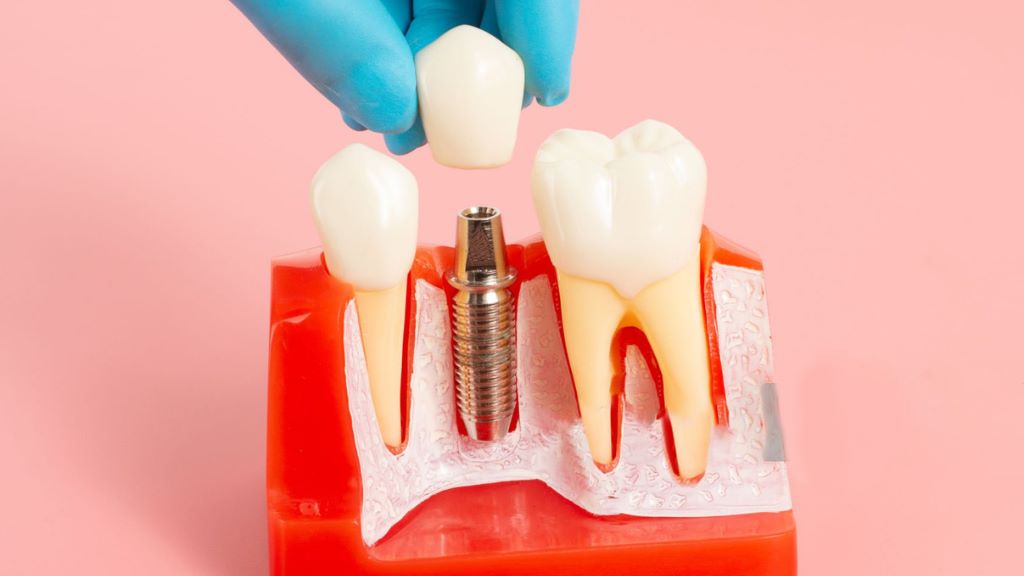
Dental implants are artificial tooth roots made of titanium that are placed in the jawbone to replace the root of a missing tooth. They provide a strong foundation for supporting a dental crown, bridge or denture, helping restore the appearance and function of missing teeth. Dental implants are a suitable option for individuals who prefer a fixed replacement for one or more missing teeth.
Once the implant is placed successfully, it helps restore chewing function and supports the natural shape of the dental arch. Replacing the missing tooth root also helps maintain the surrounding bone, which may otherwise reduce over time after tooth loss. Maintaining good bone health, practising proper oral hygiene and attending regular dental check-ups play an important role in the long-term success of dental implants
Signs you may need Dental Implants
After a detailed examination, your dentist will recommend the most suitable treatment based on your individual dental needs.
- One or more missing natural teeth.
- A severely cracked or broken tooth that cannot be restored.
- Loose-fitting partial dentures that affect your comfort.
- Difficulty chewing, eating or speaking because of missing teeth.
- Changes in facial appearance caused by tooth loss.
- A severely infected tooth that requires replacement.
Benefits of Dental Implants
Dental implants provide a stable replacement that allows you to carry out everyday activities with greater comfort and confidence.
Some of the key benefits include:
- Helps preserve the supporting bone and gum tissues.
- Distributes chewing forces evenly to help protect healthy neighbouring teeth.
- Prevents adjacent teeth from shifting into the empty space.
- Restores comfortable chewing and supports clearer speech.
- Eliminates the need for removable dentures for suitable patients.
- Avoids the need to modify healthy neighbouring teeth for a fixed tooth replacement.
- Provides a dependable option for replacing missing teeth when maintained with proper oral care.
Process of Dental Implants
Dental implant treatment is planned carefully to ensure the implant is placed accurately and functions effectively. At Dr. Tejani’s dental studio our Implantologists will thoroughly examine and give best treatment options for implants according to individual needs.
The treatment is performed under adequate anaesthesia to ensure patient comfort throughout the procedure. Depending on the clinical condition, immediate implant placement may be recommended after tooth extraction. Flapless implant placement, also known as a cut-free and stitch-free technique, may also be considered in suitable cases to improve patient comfort and recovery.
The procedure generally includes:
- Diagnosis and Treatment Planning includes a detailed examination along with the required X-rays or scans to plan the dental implant treatment.
- Tooth Extraction and Dental Implant Placement are performed if the affected tooth requires removal before the implant is placed.
- Temporary Teeth Replacement may be provided during the healing period, depending on the treatment plan.
- Permanent Teeth Replacement is completed after healing with measurements or digital scans, followed by bite measurements, a teeth trial and the final placement of the permanent teeth.
Types of Dental Implants
Dental implant treatment can be customised to replace a single missing tooth, multiple missing teeth or an entire set of teeth. The most suitable treatment option is recommended after evaluating your oral health, the number of missing teeth and your individual treatment needs.
The available treatment options include:
- Single Tooth Replacement uses a single dental implant to support an individual dental crown and restore a missing tooth.
- Multiple Teeth Replacement uses multiple dental implants to support a fixed dental bridge for replacing several missing teeth.
- Full Arch Replacement restores all the teeth in one jaw using multiple dental implants with a fixed hybrid denture.
- Full Mouth Replacement replaces missing teeth in both the upper and lower jaws using multiple dental implants with fixed hybrid dentures.
Implant Hybrid Denture / All-on-4 / All-on-6 / All-on-X
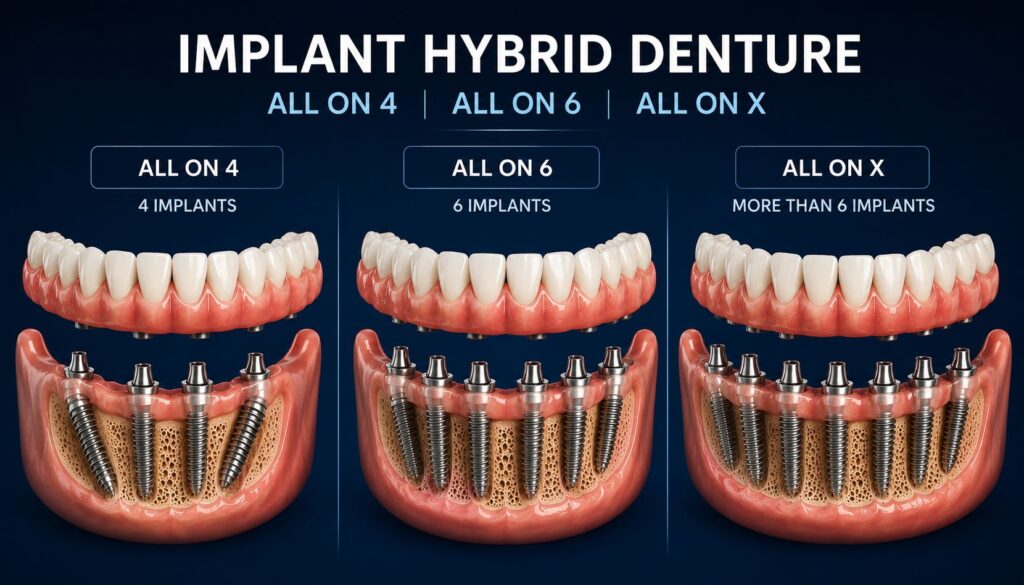
Hybrid dentures, also known as All-on-4, All-on-6 or All-on-X, are full-jaw fixed dentures supported by dental implants. They provide improved stability, support and a natural-looking smile while eliminating the need for removable dentures. Treatment duration may vary from a few days to a few months depending on the patient’s oral condition and treatment requirements. Hybrid dentures consist of an inner metal framework with artificial teeth placed over it to restore function and appearance.
Benefits of Implant Hybrid Denture
Implant-supported hybrid dentures are designed to provide a stable, fixed and functional replacement for missing teeth. They improve everyday comfort while restoring the appearance and function of your smile.
Some of the key benefits include:
- Improved stability and retention for better support.
- Enhanced chewing efficiency for improved oral function.
- Better speech clarity during everyday conversations.
- Improved aesthetic appeal for a natural-looking smile.
- Reduced bone loss by supporting the underlying jawbone.
- Comfortable fit for daily use.
- Easy maintenance with proper oral hygiene.
Materials used
The inner framework and replacement teeth can be fabricated using different materials based on the treatment requirements and the selected restoration.
Inner framework materials include:
- Titanium
- Chrome Cobalt
Replacement teeth materials include:
- Acrylic
- Ceramic
- Composite Resin
- Zirconia
- Graphene
When is it recommended?
Implant-supported hybrid dentures may be recommended for patients requiring a fixed solution for replacing multiple or all missing teeth. We will recommend the most suitable treatment after evaluating your oral condition and treatment needs.
It may be recommended for:
- Patients with complete tooth loss.
- Patients with partial tooth loss.
- Patients receiving dental implant treatment.
- Patients with bone loss or bone resorption.
- Patients looking for improved denture stability.
Procedure
The implant hybrid denture procedure is planned according to the patient’s treatment requirements. The number of appointments and treatment duration may vary depending on the individual’s oral condition.
The procedure generally includes:
- Tooth extraction and implant placement if the affected teeth has to be removed.
- Temporary teeth fixation when recommended during the healing period.
- Healing period of 3 – 6 months to allow the dental implants to integrate with the jawbone.
- Digital impressions or scanning to record the implant position for the final restoration.
- Fabrication of the hybrid denture based on the treatment plan.
- Final fitting and adjustments before securing the restoration.
Cost of Dental Implants
After a detailed clinical evaluation, your dentist will recommend a personalised treatment plan along with a cost estimate.
- Single Dental Implant starts from ₹30,000.
- Full Jaw Teeth Replacement with Dental Implants starts from ₹1,70,000.
The final cost may vary depending on various factors –
- Brand of dental implants,
- Material selected for the replacement teeth
- If any, additional procedures such as artificial bone grafting are required during treatment.
Advantages over Traditional Dentures
Dental implants offer several advantages over conventional removable dentures by providing improved function, comfort and stability. They are designed to support everyday activities while restoring the appearance of missing teeth.
Some of the key advantages include:
- Improved stability for a more secure fit.
- Enhanced chewing efficiency for better oral function.
- Reduced bone loss by supporting the underlying jawbone.
- Increased confidence while eating, speaking and smiling.
- Improved aesthetics for a more natural appearance.
- Fixed teeth without the inconvenience of removable dentures.
- Easy maintenance with proper oral hygiene and regular dental care.
How long do Dental Implants last?
Dental implants can last for many years and even a lifetime when they are placed correctly and maintained with proper oral care. The health of the surrounding teeth also plays an important role in protecting the implants from excessive stress and supporting their long-term function. Although the crowns or bridges attached to the implants may experience normal wear over time and require replacement, the underlying dental implant can continue to remain in place.
Precautions with Dental Implants
Following the recommended aftercare instructions helps maintain the health of your dental implants and supports their long-term success. After dental implant treatment, it is recommended to:
- Avoid using your teeth to tear or break hard objects to prevent unnecessary stress on the implants.
- Maintain good oral hygiene by brushing and flossing twice daily as advised by the dentist.
- Attend regular dental check-ups to monitor the condition of the implants and surrounding tissues.
- Follow your dentist’s oral care instructions to maintain healthy dental implants over time.
Possible risks of Dental Implant Treatment
Dental implant placement is a minor surgical procedure which has risks associated like any surgical treatment. Before planning the procedure, your dentist will evaluate your medical history and recommend the necessary investigations to ensure safe and successful treatment.
Possible risks and considerations include:
- Medical conditions such as diabetes or heart disease should be discussed before treatment.
- Current medications should be disclosed to your dentist before the procedure.
- Dental X-rays, scans or blood investigations may be recommended to assess healing and treatment suitability.
- Peri-implantitis and bone loss around the implant are among the most common causes of long-term implant failure.
- Proper treatment planning, good oral hygiene and regular maintenance play an important role in reducing the risk of implant-related complications.
Dental implants should be considered a valuable investment, as a well-planned treatment that can significantly improve oral function and overall well-being. Dental implants can be a valuable investment when treatment is planned based on your oral health, bone condition and individual requirements. A thorough assessment helps determine whether implants are suitable for you and allows the treatment to be planned with the right approach from the beginning. Discussing your options with your dentist can help you make an informed decision based on your needs and expectations.
FAQ
Is getting a dental implant painful?
The implant procedure is performed under adequate anaesthesia, so you should not feel pain during the procedure. Some soreness, swelling or discomfort may occur after treatment and usually settles as the area heals.
Can smokers get dental implants?
Smoking can interfere with healing and increase the risk of implant-related complications. If you smoke, discuss it with our dentist before treatment so your individual risks can be assessed and appropriate advice can be given.
Do I need a bone graft before getting a dental implant?
Not everyone needs a bone graft. If there is not enough bone to provide adequate support for an implant, your dentist may recommend bone grafting or another procedure to improve the available bone before or during implant treatment.
What happens if a dental implant does not fuse with the jawbone?
If an implant does not integrate properly with the surrounding bone, it may not provide the stability needed to support the replacement tooth. Your dentist will assess the implant and determine the appropriate next step.
Can a dental implant become loose after it has healed?
A properly integrated implant should remain stable. If an implant or the restoration attached to it becomes loose, it should be examined by your dentist to identify the cause and prevent further complications.
Can an implant develop a cavity like a natural tooth?
The implant itself cannot develop a cavity because it is not a natural tooth. However, the crown attached to the implant and the surrounding gums still need proper care to maintain their health.
What are the signs that something may be wrong with dental implants?
Persistent pain, swelling, bleeding around the implant, looseness or difficulty chewing should be evaluated by a dentist. Early assessment can help identify problems affecting the implant or surrounding tissues.
Can I get a dental implant if I have been missing a tooth for many years?
Possibly. The suitability of an implant depends on the condition of your jawbone and surrounding tissues, along with your overall oral health. If there is insufficient bone, additional treatment may be required before implant placement.
Can dental implants be placed if I have an infection in the tooth or gums?
An active dental infection may need to be treated before implant placement. Our dentist will assess the affected area and determine when it is appropriate to proceed with implant treatment.
Can I have dental implants if I take regular medicines?
Some medicines can affect healing or the way implant treatment is planned. Tell the dentist about all medicines you take so they can assess your individual situation before treatment.
What happens if the crown or artificial tooth on my implant gets damaged?
The restoration attached to an implant can sometimes be repaired or replaced without removing the implant itself. Your dentist will examine the restoration and implant to determine the most appropriate solution.